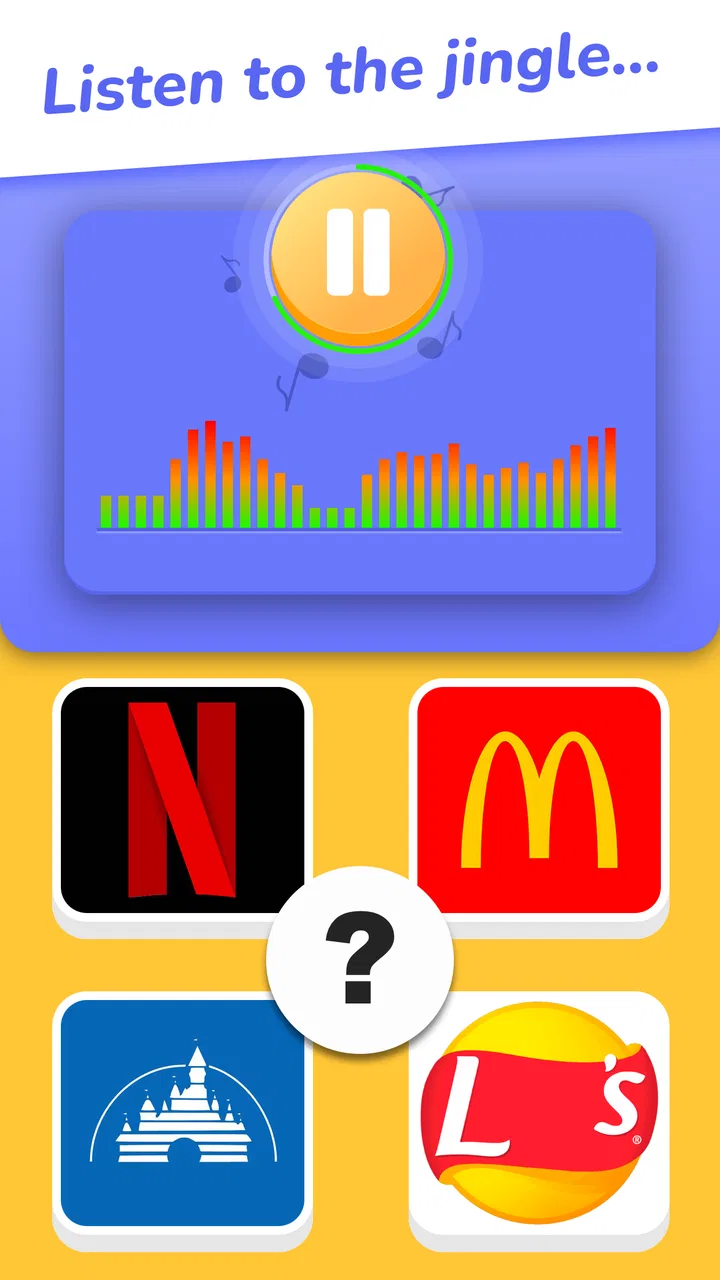
Jingle Quiz: logo music trivia
- 4.4
- Rating
- 1.00M
- Installs
- Free
- Price

 Analysis by App-foxy
I enjoy trivia games that give me a quick challenge without asking me to learn a complicated interface first. Jingle Quiz takes that idea in a particularly recognizable direction: instead of showing a logo and asking me to name a company, it turns familiar brand sounds into the clues. That makes each round feel like a small memory test, part music quiz and part logo knowledge game.
My first impression was that the concept is easy to understand but more demanding than it sounds. A visual logo can often be identified from its colors or shape. A short sound gives me fewer obvious details, so I have to pay attention to rhythm, melody, voice, and the feeling attached to a brand. Sometimes I know the answer immediately; other times I recognize the jingle but cannot connect it to the name quickly enough.
This is a free trivia game from SAS ELIA, aimed at Everyone, and it works best when I want something light for a spare moment. It is not a replacement for a full music-learning app or a deep general-knowledge quiz. Its appeal is narrower and clearer: it tests how well I remember commercial sounds and how quickly I can connect audio with familiar logos.
You May Also Like

 Blood Strike: 2.5 Anniversary
Blood Strike’s Loadouts Turn Every Drop Into a Tactical Gamble
A close look at Blood Strike’s custom loadouts: how fast access to signature weapons reshapes its battle royale rhythm, rewards preparation, and narrows the gap between fights.

 Pandora - Music & Podcasts
Pandora’s Music Is Easy to Start, but Harder to Recover
Pandora’s strength is its low-effort path from a seed to a station. Its weak spot is how much confidence it asks you to place in connection, setup, and quiet recovery.

 8 Ball Pool
 Is Built on Rivalries, Rematches, and Routine
A close look at the rivalries, rematches, shared routines, and unanswered safety questions that turn a quick pool match into a persistent mobile community.

 Samsung Music
’s Quiet Strength Is Playing What You Already Own
Its reach comes less from spectacle than from dependable access to a personal library. That simplicity is both the app’s strongest retention engine and its ceiling.

 AccuWeather: Weather Radar
AccuWeather Review: A Quick, Clear Forecast for Everyday Decisions
For everyday plans, the best forecast is the one you can understand quickly. AccuWeather makes rain timing, radar, and local conditions easy to act on, with a few trade-offs.

 Hill Climb Racing
Why Hill Climb Racing Still Turns Crashes Into One More Run
A tiny car, a bumpy hill and one more upgrade: Hill Climb Racing keeps resurfacing because its simple chaos makes every near-miss feel personal.
More From Our News Desk



What I consider before choosing this kind of trivia game
When I choose an audio-based trivia game, I first think about whether I’ll have the attention and listening conditions to enjoy it, not just whether the premise sounds fun. I also weigh how much I value a focused theme against the variety of a broader quiz. That trade-off helps explain why this kind of game can feel engaging in short bursts yet still depend heavily on my interests.
The central question is whether sound-based recall suits you
Before choosing this game, I would ask myself whether I enjoy recognizing things by ear. Traditional logo quizzes reward visual memory, while ordinary music trivia usually focuses on artists, lyrics, albums, or genres. This game sits between those categories. The answer depends on a brand identity expressed through music or sound, so success comes from a mixture of listening and cultural familiarity.
That distinction matters. If I am good at remembering melodies but rarely notice advertising, I may find some rounds unexpectedly difficult. On the other hand, someone who remembers commercials, channel idents, product launches, or radio spots may have an advantage even without considering themselves a music expert. The game does not require formal musical knowledge; it rewards recognition.
Short sessions are a major part of the appeal
I see this as a game for small gaps in the day rather than a title that demands a long, uninterrupted session. It fits a coffee break, a short wait, or a relaxed moment when I want to put my phone down quickly. The premise is immediate, and I do not need to understand a large set of rules before starting.
That simplicity also creates a useful decision point. If I want a trivia experience with long explanations, detailed learning material, or a broad range of subjects, another category will probably suit me better. If I want fast audio prompts that test recognition, the focused format is more convincing.
Think about your listening environment
Because the clues are sounds, the surroundings affect the experience more than they would in a purely visual quiz. In a quiet room, I can concentrate on small musical details. On public transport or in a busy home, I may miss the opening or confuse a short jingle with another one. I would not judge the game fairly while multitasking or listening through a noisy environment.
A practical habit helped me: when I was unsure, I stopped trying to guess from the first impression and listened for the structure of the sound. Was it a sung phrase, a repeated note, a voice, or a distinctive ending? That approach turns random guessing into a more deliberate memory exercise.
How the game compares with familiar alternatives
Compared with a standard logo quiz, this title removes much of the visual assistance. That makes it less accessible for players who prefer pattern matching, but more interesting for people who already know common logos and want a different challenge. Compared with broad music trivia, it is more specific: the goal is not to identify a performer or song, but to connect a sound with a brand identity.
That narrow focus is both its strength and its limitation. It gives the game a clear personality, yet it may feel repetitive to someone who wants constantly changing subjects. I would choose it over a general quiz when I want a themed challenge, but I would choose a broader trivia app when I am playing with people who have very different interests.
Where Jingle Quiz works especially well
I find Jingle Quiz most useful when I can give each sound a moment of proper attention, especially in a relaxed break or when playing alongside someone who remembers different brands than I do. In those situations, the guessing becomes a shared exercise in comparing memories rather than simply racing to an answer. The next section looks at why that small social element can make its narrow focus feel worthwhile.
It makes familiar sounds feel newly challenging
The strongest idea here is the change in perspective. A sound that normally passes unnoticed in an advertisement becomes the entire question. I found myself separating the sound from its usual context and asking what made it recognizable. That small shift makes the game more engaging than simply looking at a logo and typing the obvious name.
There is also a satisfying moment when I know the tune but hesitate over the exact answer. That gap between recognition and recall is where the game earns its place as trivia rather than passive listening. It encourages me to trust my memory, consider related possibilities, and pay attention to details I would usually ignore.
It is approachable for mixed-age play
The Everyone content rating makes sense for the basic concept. There is no need for specialized knowledge to begin, and the audio clue format can work for casual players as well as people who enjoy quizzes regularly. I could imagine using it with family members because each person may recognize different sounds for different reasons.
That does not mean every round will be equally familiar to everyone. Recognition can depend on where someone lives, what media they consume, and which products they encounter. For group play, I would treat wrong answers as part of the conversation rather than assuming the most confident player is always right. The game is more enjoyable when people explain why a sound feels familiar.
It encourages a useful listening technique
One of the less obvious benefits is that it trains attention to short audio signatures. I started listening for the first few seconds, the final note, and the way a voice or melody was presented. This is a transferable habit for anyone who wants to become better at identifying sounds, even though the game itself remains casual rather than educational.
My recommendation is to avoid answering too quickly when the sound seems almost familiar. I mentally described it before choosing: upbeat or calm, vocal or instrumental, repetitive or flowing. That extra step helped me distinguish genuine recognition from the common feeling that I had heard something similar before.
Its popularity gives it a reassuring starting point
The game has an average rating of 4.4 from around 31 thousand ratings, and it has passed 1 million installs. Those figures do not guarantee that every player will enjoy the same clues, but they do suggest that the central idea has found a substantial audience. I would take that as a reason to try it, not as a substitute for deciding whether audio trivia is personally appealing.
The developer, SAS ELIA, has kept the identity of the product easy to understand. I never felt that I needed a separate explanation to know what kind of experience I was opening. That clarity is valuable in a free game, especially when I am choosing something quickly from a crowded trivia category.
A realistic everyday use case
Imagine having ten minutes before an appointment. A long quiz with multiple categories may be awkward because I might not want to stop halfway through a complicated sequence. This game is better suited to that moment: I can listen, make a guess, and leave when I need to. The same applies to a relaxed evening when I want a low-pressure activity instead of a competitive multiplayer session.
I also think it works well as a conversation starter. One person can recognize a sound while another remembers where they heard it. Even when the answer is missed, the discussion about the source of the memory can be entertaining. That social value is easy to overlook because the app is presented as a solo quiz, but audio recognition naturally invites people to compare memories.
What the current release means in practice
The current version is 26.5.0, and the minimum operating system is Android 7.0. For someone using a reasonably recent Android device, that requirement should not be a major obstacle. I would still check compatibility before planning to use it on an older phone, particularly if the device has been kept on an outdated system for a long time.
The important point is that this is a focused game rather than a large platform with many unrelated activities. I appreciate that focus when I want logo music trivia specifically. I would not install it expecting a complete collection of music games, a general knowledge course, or a tool for identifying any song I hear in daily life.
Small tactics that improve the experience
I found three habits especially useful. First, I listen to the whole clue before committing, because the ending can be more distinctive than the opening. Second, I separate the sound itself from the product category I associate with it; my first association is not always the correct one. Third, I treat uncertainty as information and compare the rhythm, voice, and mood with memories rather than tapping randomly.
Those tactics also reveal the game’s real trade-off. The more carefully I listen, the more rewarding the challenge becomes, but careful listening takes more attention than a quick visual quiz. Players who want instant answers may find that effort unnecessary. Players who enjoy solving a clue through small details will likely appreciate it.
Where other choices may fit better
I would steer someone toward a conventional logo quiz if their main pleasure comes from visual puzzles or if they prefer playing with the sound muted. I would choose a broad music-trivia game for a group with strong knowledge of artists, lyrics, and musical history. I would also look elsewhere if the goal is to identify songs from everyday life, because this game is built around brand-related sounds rather than open-ended music recognition.
Another alternative category is a general trivia game with many subjects. That type offers more variety and may remain fresh for longer sessions. The trade-off is that it usually cannot provide the same concentrated test of auditory brand memory. Choosing between them depends on whether I value breadth or a distinctive theme.
There is also a personal knowledge factor. If I do not recognize many of the brands represented by the clues, the game may feel less fair or less satisfying even when the mechanics are clear. In that situation, a quiz based on universal facts or visual logic would probably be a better fit. This is not a flaw in the concept; it is a reminder that recognition-based games depend on shared cultural exposure.
Free access and the cost of switching
The game is free to download, which makes trying it a low-commitment decision. It includes in-app purchases ranging from $1.99 to $19.99 per item, so I would approach optional spending carefully and decide first whether the core challenge holds my attention. A free starting point is useful here because the theme is quite specific; not everyone will enjoy it for more than a few sessions.
For me, the cost of switching to another trivia category is low. If I want visual logos, I can move to a logo-focused quiz. If I want artists and songs, I can select music trivia. The reason to stay with this game is not that it covers everything, but that it offers a particular kind of recognition challenge that those alternatives do not reproduce in the same way.
Before spending anything, I would also consider how often I play. Occasional players may get enough enjoyment from short sessions without needing extras. Frequent players should decide whether additional content or convenience is genuinely improving the experience rather than simply extending a theme that has already become familiar. That is a sensible approach for any free quiz with optional purchases.
Who should install it, and who should skip it
I recommend it to people who enjoy brand recognition, short music challenges, and quizzes that can be played in brief bursts. It is especially suitable for players who like testing memory without reading long questions. Families and friends may also enjoy comparing which sounds they recognize, provided everyone understands that familiarity varies.
I would skip it if I want deep factual explanations, a large collection of unrelated trivia topics, or a tool for identifying any song. I would also hesitate if I usually play with audio unavailable or if I find advertising-related themes uninteresting. In those cases, the central mechanic loses much of its value, and another quiz category would be a more natural choice.
My recommendation after weighing the trade-offs
My final view is positive, with a clear condition: you should enjoy sound-based recognition. The game has a memorable premise, a low barrier to entry, and enough tension in each clue to make familiar brand music feel like a real puzzle. Its free price makes experimentation easy, while the Everyone rating broadens its usefulness for casual household play.
At the same time, I would not call it the best trivia choice for everyone. Its subject is deliberately narrow, and the experience depends on hearing the clues clearly and sharing enough cultural familiarity with them. The optional purchase range also means I would play first and spend later, if at all.
My recommendation is to try Jingle Quiz when you want a quick, audio-led challenge rather than a complete trivia library. If the first few rounds make you listen more closely to sounds you normally ignore, the concept is doing exactly what it should. If you prefer visual puzzles, broad facts, or traditional music questions, switching categories will probably give you more lasting enjoyment.
FAQs for Jingle Quiz: logo music trivia
01What is Jingle Quiz: logo music trivia all about?
Jingle Quiz: logo music trivia is a fun and engaging quiz app that challenges users to identify logos and music jingles from various brands and media. The game tests your knowledge and memory by presenting different snippets of tunes or images, asking you to guess the origin. It's perfect for trivia lovers who enjoy a mix of visual and auditory challenges.
02Is Jingle Quiz: logo music trivia free to play?
Yes, Jingle Quiz: logo music trivia is free to download and play on both Android and iOS devices. However, the app may offer in-app purchases or ads to enhance the gaming experience or unlock additional content. These purchases are optional, and the core game can be enjoyed without spending money.
03Does Jingle Quiz require an internet connection?
Jingle Quiz: logo music trivia requires an internet connection to download new content, updates, and verify answers. However, some levels may be playable offline once they are downloaded. For the full experience, including leaderboards and social features, a stable internet connection is recommended.
04What age group is Jingle Quiz suitable for?
Jingle Quiz: logo music trivia is designed for players of all ages. The intuitive gameplay and familiar jingles make it suitable for both younger and older audiences. Parents should note that the app may include ads or in-app purchases, so parental guidance is suggested for younger players.
05How does Jingle Quiz handle user data and privacy?
Jingle Quiz: logo music trivia prioritizes user privacy and data security. The app collects minimal data, primarily for gameplay and improving user experience. It adheres to standard privacy protocols and guidelines. Users should review the privacy policy within the app to understand what data is collected and how it is used.
Pros
- Engaging and fun gameplay experience.
- Wide range of music genres included.
- User-friendly interface design.
- Regular updates with new content.
- Challenging levels for advanced players.
Cons
- In-app purchases can be pricey.
- Occasional ads disrupt gameplay.
- Requires internet for full features.
- Limited hints without purchase.
- Some songs may be region-specific.

Jingle Quiz: logo music trivia
Gallery